

| Title | Name / Key Education and Experience |
|---|---|
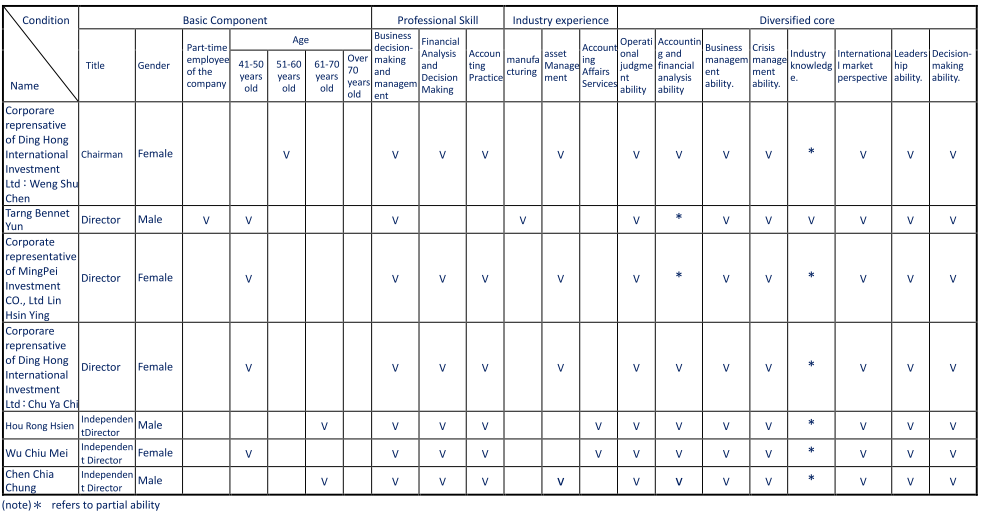
| Chairman (Corporate Representative) | Ding-Hong International Investment Co., Ltd. Representative: Weng, Shu-Chen Dept. of Accounting, Chinese Culture University Senior Assistant Vice President at E.SUN Securities; Prudential Financial |
| Director | Tarng, Bennet-Yun Master of Electrical Engineering, Illinois State University, USA Lead Engineer at TSMC; Engineer at Lucent Technologies, USA |
| Director (Corporate Representative) | Ming-Pei Investment Co., Ltd. Representative: Lin, Hsin-Ying Master's Degree, Columbia University, USA Senior Engineer at Taiwan Semiconductor Manufacturing Co., Ltd. (TSMC) |
| Director (Corporate Representative) | Ding-Hong International Investment Co., Ltd. Representative: Chu, Ya-Chi Dept. of Statistics, National Cheng Kung University Supervisor at Wintek Corporation; Supervisor at Jentech Precision Industrial Co., Ltd. |
| Independent Director | Hou, Rong-Hsien Dept. of Accounting, National Chung Hsing University; Master of Accounting, NCKU Managing Partner of Kaohsiung Office, EY Taiwan; Adjunct Lecturer, Dept. of Accounting, NCKU |
| Independent Director | Chen, Chia-Chung Graduate Institute of Agricultural Economics, National Taiwan University President of E.SUN Bank (China) Headquarters |
| Independent Director | Wu, Chiu-Mei Master of Accounting, Yuan Ze University Assistant Manager at Deloitte Taiwan; Audit Manager at E-Ton Solar Tech. Co., Ltd. |
| Management Goal | Status | Description |
|---|---|---|
| Recruit talent with diverse professional backgrounds, skills, and industrial experience. | Achieved | The current Board consists of seven members from the industry with expertise in electronics, electrical engineering, and financial management. |
| The Board should include at least one female member. | Achieved | Four out of the seven current Board members are female. |
| Directors who are also employees should not exceed one-third of the Board seats. | Achieved | Only one out of the seven current Board members is an employee, which is less than one-third of the total seats. |
| Independent directors should not serve more than three consecutive terms. | Achieved | None of the three current independent directors have served more than three consecutive terms. |
In accordance with the "Performance Evaluation Measures for the Board of Directors and Functional Committees," an internal Board performance evaluation is conducted at least once a year. The results serve as a reference for the selection or nomination of directors.
| Scope of Evaluation | Evaluation Method | Evaluation Criteria | Evaluation Results |
|---|---|---|---|
| Board of Directors | Evaluated by the Chairman |
|
|
| Board Members | Self-assessment by Board members |
|
|
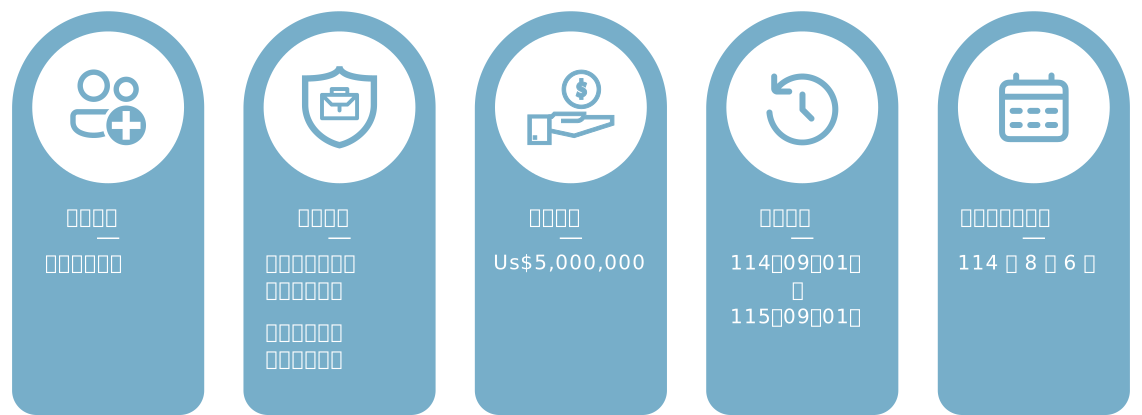
1. To strengthen risk management and protect shareholder interests, the Company has purchased liability insurance for directors and managers.
2. The status of liability insurance purchased for directors and managers in fiscal year 2025 is as follows:
Implementation Status:
The Company conducts educational training at least once a year for directors, managers, and employees on "Management of Material Inside Information and Prevention of Insider Trading," "Corporate Governance Best Practice Principles," and relevant laws. Training is arranged for new directors and managers upon their appointment, and for new employees during pre-employment training by the Management Department.
In fiscal year 2025, on November 5, a 3-hour educational session was held for 42 participants (directors, managers, and employees). The course covered: confidentiality of material information, causes of insider trading, the identification process, transaction case studies, the scope of material inside information, confidentiality procedures, disclosure procedures, and handling of violations.
During the annual training, directors are reminded not to trade their shares during the "closed periods" (30 days prior to the announcement of annual financial reports and 15 days prior to the announcement of quarterly financial reports). The Company also notifies directors via email before each quarterly announcement to prevent violations.
Board Member Succession Planning
The Company's directors are elected via a candidate nomination system for a three-year term. Unless otherwise provided by law or the Articles of Incorporation, directors are selected in accordance with the Company's Director Election Procedures. Selection considers the overall configuration of the Board and diversity in its composition, tailored to the Company's operations and development needs. The diversity policy includes, but is not limited to, the following two criteria:
(I) Basic Conditions and Values: Gender, age, nationality, and culture.
(II) Professional Knowledge and Skills: Background (e.g., law, accounting, industry, finance, marketing, or technology), professional skills, and industrial experience.
To achieve corporate governance goals, directors should generally possess the knowledge, skills, and literacy required to perform their duties. Collectively, the Board should possess the following capabilities:
1. Operational judgment
2. Accounting and financial analysis
3. Management capability (including management of subsidiaries)
4. Crisis management
5. Industry knowledge
6. International market perspective
7. Leadership
8. Decision-making
9. Risk management knowledge and capability
The Company plans for Board successors through the following methods:
(I) Recommendations of suitable candidates by current directors.
(II) Recommendations by shareholders.
(III) Using Board performance evaluation results as a reference for reappointment.
Key Management Succession Planning
Successors for management must possess execution capability, correct values, integrity, and uprightness. They must follow the corporate philosophy of "Honesty, Hard Work, Innovation, and Progress" and strive to achieve the win-win goal of employee, customer, and shareholder satisfaction.
Employees at the manager level and above are considered key management. A deputy system has been established, where each position has a designated deputy who receives training. In addition to internal management training, decision-making capabilities are cultivated through job rotation and external assignments.
